According to the Rev. Jim Frisbee, a robust understanding of Christian Stewardship demands that we take into account the safety of others, even if that causes us to bend or break a few rules.
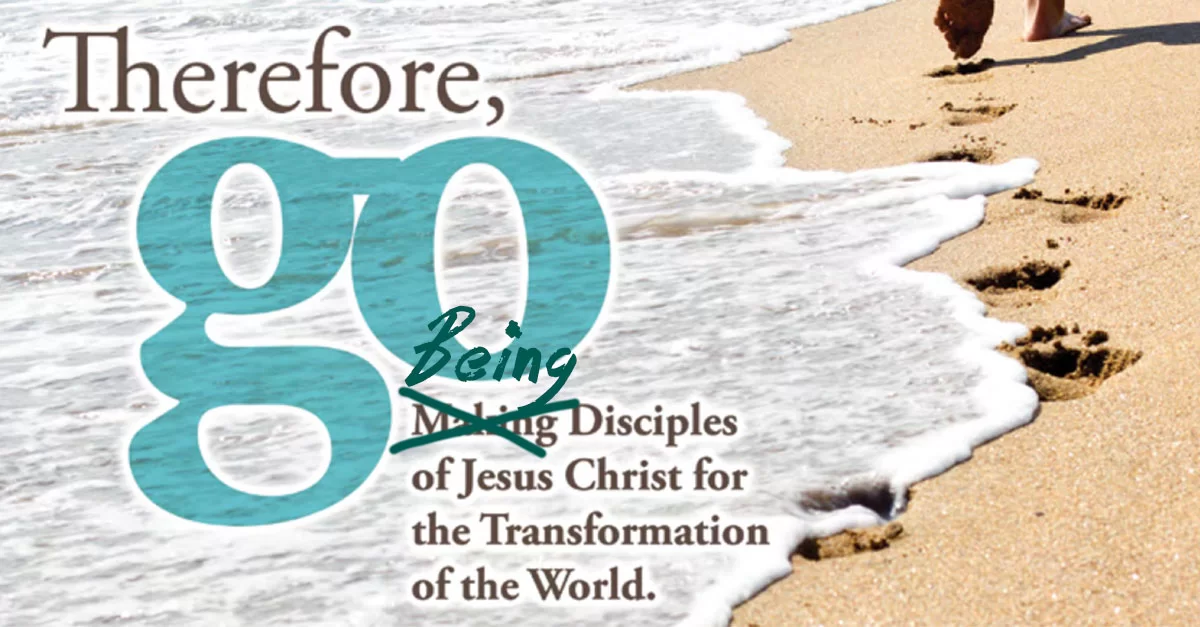
"Maybe we can't make disciples [until we] act like disciples of Jesus Christ?"
In a post for the CrossOver year study, Rev. Lowell Greathouse wonders if there is a fundamental change needed in The United Methodist Church's mission statement.
When I attended Candler School of Theology, I had the chance to go to Cuba with the World Methodist Evangelism Institute on a religious visa. I could talk for days about all of my experiences. It was amazing. As a lifelong United Methodist, it was my first personal experience with the charismatic church, and I witnessed the Holy Spirit moving in new and inspiring ways. It was intense, and it was life changing.
Two of the other participants, Kathy and Sharletta, were also from my seminary and when we returned to Atlanta, we came home with the recognition that we were responsible for our own faith formation. It may seem obvious, but at a theology school, we kind of thought we would be handed the best practices. In Cuba, we humbly realized that wasn’t the case. No one was going to “do” our faith for us. We weren’t going to mature as disciples by osmosis. We had to choose to pray, to worship, to engage in fellowship, to serve others, and to study for ourselves.
So, we decided to meet weekly to sing, share with one another, and pray. We met faithfully each week in the same space. Our time together wasn’t formal, but the rituals formed organically among us. We would start by checking in, talking about life, family, and our own needs. It was like “joys and concerns” but with deep focused attention on each of us. We could choose to share as we needed and share again if something else came up. We took turns praying however we felt led—for each other, and sometimes for our own requests. Sharletta had a beautiful voice and easily drifted from spoken words to singing, and we would join her. Her readiness to sing drew out our own inclination to sing and so it came to be that any of us might lead with a prayer or song at any point in our time together.
We also learned to be comfortable in the silences. We didn’t rush to talk or pray the next prayer. We intentionally slowed down, leaving space for each other and created space for the Holy Spirit. All of that happened in our first year of seminary. Our time together was so valuable we continued it until the end of our third year when we graduated. Over the years, we invited other friends to join us. Some came once or twice, others joined for a season, and others joined and never left.
All of that was more than 13 years ago and it still stands as one of the most profound experiences of church in my life.
As I reflect on this week’s scriptures and Brian McLaren’s chapter on worship and ecclesia (We Make the Road by Walking, Chapter 36 • The Uprising of Worship), I think of the riches of relationships in the church. We have so much to offer one another, so much to gain from investing in learning to do faith together. A quick read of the scriptures makes it sound easy. The reality is, like much in our faith, it is simple (pray, break bread, praise God, care for one another) but not easy. It takes commitment, dedication and intentionality.
Being the church together isn’t easy, but it is worth it. And when it gets really hard, it’s good to go back to what’s simple: pray, break bread, praise God, and care for one another.
Do you know that I was literally born in a parsonage? Yes, I mean literally!
My Dad loves to tell the story that on the night I was born, his favorite TV show, “Tarzan”, was on. He always says that the reason why my Mom did not make it to the hospital to give birth to me was that he was glued to the television watching. So, because of this, I can practically say that I have been in the church since the day I was born!
But when I think of call stories to faith and discipleship, I feel mine is boring. There is little to tell. There is nothing earth-shattering in my encounters with God. I was born in the church parsonage. I just grew up in the church attending Sunday School, VBS, children’s choir then youth group, prayer meetings, bibles studies and a lot of potlucks. I grew up attending church Sunday after Sunday after Sunday mostly because I didn’t have a choice as a PK (Pastor’s Kid), but then that is also how I came to know Jesus, God, and the Church!
The gospel stories tell us that Jesus called some of his disciples in simple and mundane ways as well. According to these accounts, to some, he simply said, “Follow me…”, “Come and See…” or “Let us have breakfast…” and they did. Thus, there seemed to be also nothing noteworthy about their call, but I tell you that Jesus’ call and their response to that call changed their lives forever.
From that day on they became disciples, followers of Christ… … they left their boats, their work and their families.
From then on, their lives’ purpose was radically changed… …from being fishermen they became fishers of people.
From then on, their lives were never the same.
What I am saying here is that when God calls you to faith and discipleship, that’s always a big deal whether anyone recognize it or not.
But again, my guess is that for most of us, there was also nothing earth-shattering about your call to faith. Probably some of you are like me… just grew up attending church and that is how you came to know God.
Or maybe you have friends or family who had been attending church and you just decided to join them one Sunday and that was that.
No big deal…
Nothing extraordinary we may say…
But for me, that is exactly why I believe that Jesus’ call is so profound. Behind the simple appearance of the call is a life-changing experience. For when Jesus calls us to faith, he is not just calling us to attend and be a member of the church, but rather he has called us to life anew and to be agents of change and transformation in the world.
The call can be so simple that some Christians unfortunately take their call for granted.
Yes, the call is as simple as “Come and See…” or “Follow Me…”
Thus, we can say that we are called to follow Jesus and invite others to do the same. In doing so we are building communities of God’s people who love each other and are committed to changing the world. That is how we transform the world as disciples of Jesus Christ, not by isolating ourselves from the world, not by judging the world, but simply by inviting and engaging the world into the transformative work of God.
So now, let me conclude by giving this warning. Do not allow the simplicity of the call to discipleship to fool you nor let the familiarity of faith lead you into complacency!
Be DISCIPLES OF THE RISEN CHRIST who TRANSFORM THE WORLD and invite others to do the same.
Rev. J. Mark Galang serves as Superintendent for the Puget Sound Missional District in the Pacific Northwest Annual Conference of The United Methodist Church.
He has told you, O mortal, what is good; and what does the LORD require of you but to do justice, and to love kindness, and to walk humbly with your God?
Micah 6:8, NRSV
I was doing housework—or something—with half an ear to my local National Public Radio station. The story was about a father and his children, a Latinx family. I didn’t catch the father’s country of origin, but he was undocumented. He had been detained by Immigration and Customs Enforcement (ICE) for a time, separating the family.
The story was not so much about the father’s experience as about his children’s. The children were so traumatized by the separation that, once released, they would not allow their father to run a simple errand without one of them accompanying him. Their father indulged them, taking with him the child that was ready first, knowing that the next child would be in tow on the next errand. Ah…
My immediate response was this: There, but for the grace of God, go I. There, but for my family entering the United States at a time when hard-working immigrants were valued, if not still exploited.
I do not believe that God favored my grandparents over others or that they were special in God’s eyes—no more than the children in this story. Rather, I think God smiles when barriers are removed that allow each of us to live and give into our full potential.
It makes a difference when we put ourselves into the story.
At this time in our CrossOver year, Brian McLaren asks us to enter the story of the days following Jesus death and triumph, to be present with all the pain and confusion and fear that follows witnessing cruelty and injustice. We are asked to think of the story in the first person. How would I respond? How would I feel? What role or roles would I play in this drama?
Jesus’ story is not so different from prophets throughout history who have pushed back against power and suffered the ultimate sacrifice for their leadership – with one exception. Jesus showed us that it does not end there. It cannot end there. It must not end there. Jesus shows us – present tense – that love prevails. But not without us.
You are sent. You are accompanied. You forgive.
Place yourself there in that upper room; or in a family of immigrants who do not know if their father will return each time he leaves home; or with a mother who cannot afford health care for her children; or with an LGBTQ+ sibling who feels disaffirmed in their personhood; or with… With.
Can I put myself in that place of profound uncertainty? Who are my companions along the journey? Can I both enter their story and allow others to enter my own? Can I be in fellowship that is deep and life-changing?
McLaren defines fellowship in this way: “Fellowship is a kind of belonging that isn’t based on status, achievement, or gender, but instead is based on a deep belief that everyone matters, everyone is welcome, and everyone is loved, no conditions, no exceptions.”[1]
McLaren makes the case that fellowship is what was present in that small room where Jesus’ followers were huddled and where he appeared to assure his beloved that God’s kinship had a future in them. In us.
So…to the challenge of placing the Gospel in First Person…of entering that profound fellowship, here will be my test:
Can I say of another’s story, There, but for the grace of God, go I? What is your test?
Kristina Gonzalez serves as Director of Innovation for an Inclusive Church on the Innovation Vitality Team in its work for the Greater Northwest Area of The United Methodist Church.
[1]McLaren, Brian. We Make the Road by Walking, Chapter 34, page 175.
Des Moines, Wash. – Last weekend, over 60 leaders from the Alaska, Oregon-Idaho (OR-ID), and Pacific Northwest (PNW) Conferences gathered to continue conversations on how they could marshal resources toward vital mission and ministry across the Greater Northwest Area. The Vitality Stewards Summit 2.0, as the name suggests, was the second formal gathering aimed toward this task, expanding the circle of those who met in September of 2018.
The event began by orientating new and returning “stewards” on the aspirations of the summit and some of the resources that the area has available to it. An opening devotional by Rev. Shalom Agtarap, centered on the story of the early church in Acts, emphasized the opportunity and challenge of sharing. Agtarap asked, “How can we move from a transactional economy to one of kinship?”
Greater Northwest Area Bishop Elaine JW Stanovsky addresses “stewards” providing necessary context to the conversations that would follow.
While denominational conversations often center around scarcity, leaders were encouraged instead to recognize the significant assets under their care. Bishop Elaine JW Stanovsky shared that we often don’t consider these assets or remember that radical growth is in our DNA. “If we pool our resources, share a common vision, couldn’t we do more if we focused on a few big things?”
Stanovsky addressed the elephant in the room as she talked about the impact of General Conference upon United Methodism. Instead of being a roadblock, she framed it as an opportunity not to repeat the mistakes of the past. To avoid old behavior, we need to invite “younger, people of color, and LGBTQ+ people to the table to help shape what is coming.”
This call for more diverse leadership echoed throughout the meeting.
Stanovsky also advised that the work of the meeting be considered provisional in anticipation of the challenges, and opportunities for greater inclusion, in front of us. Drawing upon the biblical story of the crossing over into the Jordan, the bishop offered, “It’s time to leave the wilderness. Not everyone is going to cross over to the Jordan.”
Eric Walker helps to orient Vitality Stewards Summit attendees to some of the opportunity and challenges to ministry in the Greater Northwest context.
Next up was Eric Walker, who is serving as a special assistant to Bishop Stanovsky, charged in part with organizing the Summit. A lay person from Vashon UMC with non-profit management experience, Walker helped to keep the event moving, reminding participants of its goals. Those goals were:
Developing a good understanding of vitality work across the area.
Creating the first draft of Area-wide funding criteria.
Arriving at a basic agreement on the kinds of projects that would excite Area-wide funding.
Sparking movement towards a culture of Area-wide collaboration.
Walker offered a big picture look at the challenges and opportunities facing the Area as it seeks to have more churches engaged in vital ministry. Sharing that a significant number of churches are in some stage of decline, he framed the goal of innovation and vitality work across the area as bending bad trajectories toward more positive possibilities.
Throughout the Summit, the Rev. Shalom Agtarap offered moments of spiritual grounding and pause to aid in conversation and community formation.
Inclusion is the Starting Point
Rev. Dr. William Gibson followed Walker by sharing some of the learnings of the Innovation Vitality Team (IV Team). After one year together, the team has landed upon the understanding that Inclusion, Innovation, and Multiplication are crucial practices, and measures, of church vitality. More recently, they have begun to understand inclusion as foundational to the success of the other two practices.
Kristina Gonzalez offers a quick overview of Intercultural Competency, an essential tool for change in the Church and the world.
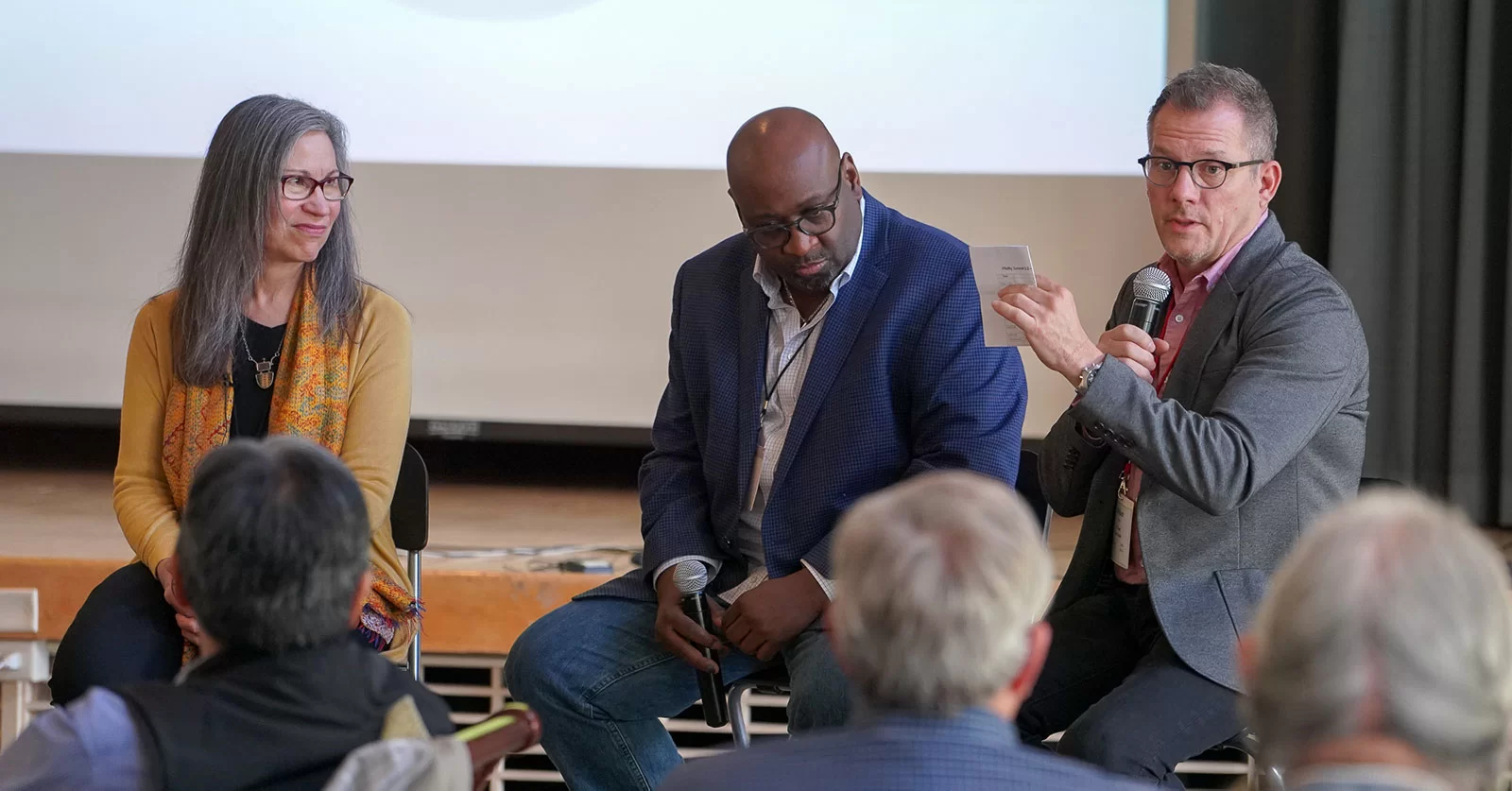
Participants next engaged in a presentation from Kristina Gonzalez, Rev. Dr. Leroy Barber, and Gibson on Intercultural Competency and its effect on the IV Team’s work. Gonzalez gave an overview of Intercultural Competency reflecting on her own choice to be a United Methodist. “The United Methodist Church appealed to me because of its emphasis on practical divinity, and the use of practical tools like Intercultural Competency to effect change.”
Barber shared how some of his work, specifically internships and revivals, had embodied these principles of inclusion in making deliberate connections between the Church, persons of color, and younger people. Some of the participants in the first cohort of interns are now being tracked to provide leadership in local churches.
Gibson concluded the IV Team’s report by sharing how they have developed new guardrails to better steward monies allocated to church plants and other revitalization projects. Experience has helped them to understand that there is no necessary correlation between age and innovative ability and that some churches “aren’t interested with changing to pivot in the moment.”
The Rev. Lisa Talbott shares a report back from her table group as leaders works to identify evaluative measures for funding.
The afternoon continued with reports from several District Superintendents and, separately, the lay leaders of each Conference. Erin Martin, chief missional strategist for the Columbia District, has been asking her district to consider what it would mean “to envision ourselves as a community of United Methodist Congregations.” A success story she shared involved the arrival of the Rev. Alan Buck, a gifted Native American church planter from Oklahoma, who is helping to revitalize Wilshire UMC, recently renamed Great Spirit UMC.
Rev. Rich Lang spoke about three practices found to be present in early Christianity, but often absent in the churches he serves in the SeaTac Missional District:
The Practice of Non-violence
The Practice of Self-emptying
The Practice of Giving Away
He shared how funds from recent church closures were being reinvested in other churches to provide multi-ethnic leadership teams toward the goal of fostering multi-ethnic communities. Lang named Valley and Mountain, soon to give birth to a third iteration, as an example of excellent ministry incarnating inclusion and innovation, leading to multiplication.
Seven Rivers Missional District Superintendent Rev. Mary Huycke offered a non-urban perspective as she serves a region stretched across the central part of Washington from the Canadian border down to Oregon. The district has intentionally invested in laity with the understanding that “clergy come and go, the laity are the ones who stick around.”
District Superintendents (from left) Erin Martin, Rich Lang, and Mary Huycke engage in a dialogue with Eric Walker after sharing perspectives from their work.
A number of the churches in her district are very small. Helping some of those churches to end their ministries gracefully, while finding creative ways to extend the life of others with alternative leadership structures, is a portion of the work. A lack of diversity, and inclusive practice, is a challenge many are wrestling against.
Offering her perspective on the OR-ID Conference, lay leader Jan Nelson shared that many laypersons there are unaware of the work of the IV Team but not incapable of embracing innovation. She pointed to the example of the Open Door Churches in the Salem area while advocating for more leadership training to make use of laity who feel under-utilized. “We need a better structure, or system, to engage laity.”
The three Area Lay Leaders, (from left) Jo Anne Hayden, Jan Nelson, and Nancy Tam Davis, each speak to the value of including and equipping and lay persons.
PNW Conference lay leader Nancy Tam Davis also noted the absence of leadership development among lay people in her conference. She added that Certified Lay Ministers were often serving in challenging appointments but lacked the same network of support afforded to clergy. “Morale is low,” said Davis. “How do we bring lay leaders together for support?”
Jo Anne Hayden, lay leader in the Alaska Conference, named some of the same concerns. On a conference-level, there are efforts to train local church leaders underway through Zoom with hopes to expand the number of groups soon.
How we are working together already
Conference Treasurers Brant Henshaw (AK, PNW) and Rev. Dan Wilson-Fey offer some financial insights.
The second day began with a presentation by the Area treasurers detailing some of the resources available for vitality work and some of their other projections. Currently, expenses for shared work are split between conferences – PNW (54%), OR-ID (40), and AK (6%) based on conference size and budgets.
Disaster response leaders in the OR-ID and PNW Conferences shared how they have been collaborating because it makes sense. Jim Truitt began serving in March as Disaster Response Coordinator for the Greater Northwest Area, leading a pilot program building upon years of collaboration between leaders in OR-ID, PNW and Alaska.
Truitt, along with Kathy Bryson (PNW) and Dan Moesler (OR-ID) shared with the group how clear common goals, shared practices, and trainings have made collaboration work for them. Programs like “Connecting Neighbors” embody some of the vitality practices of developing intentional partnerships beyond the Church.
Jim Truitt, Disaster Response Coordinator for the Greater Northwest Area, shares his part of an update on collaboration between leaders in the Alaska, Oregon-Idaho, and Pacific Northwest Conferences.
Next up was a presentation by Revs. Karen Hernandez and Gregg Sealey, and layperson Lynn Egli. As superintendents of mostly rural districts, Hernandez and Sealey shared their excitement for the Rural Church Engagement Initiative’s promise to translate Asset Based Community Development (ABCD) training for a rural context.
Egli, described as the “Energizer Bunny behind all of this,” helped to explain how he has applied his background as a CPA for Hewlett Packard to the design and implementation of the pilot program. “We have to be demanding, to expect performance,” he shared. “It’s going to be tough for local leaders to put together a team.” He expects to learn from the pilot, and adapt subsequent iterations based on that learning.
Lynn Egli, helps to present the Rural Church Engagement Initiative with the Revs. Karen Hernandez and Gregg Sealey.
Three cohorts (including 14 pastors and local church teams) of the Rural Church Engagement Initiative are already meeting together monthly, sharing learnings and support for each other.
Representatives of Committees on Native American Ministries (CONAM) offered the final presentation on shared ministry and collaboration across the Area. Duane Medicine Crow (OR-ID) shared a desire to do more. Sharing when “we get money, we give it away,” he talked about a recent project supporting a Nez Perce intern at Wallowa Lake Camp.
Rev. Charley Brower offering some historical context on Christian missionary outreach to Native American populations in Alaska.
Rev. Charley Brower (AK) offered some historical context on Christian missionary outreach to Native American populations in Alaska and how some denominational decisions years ago continue to impact the mission field today.
Finally, Kristina Gonzalez shared how the PNW was inviting a Native American developer from OR-ID to evaluate three ministries in the conference which have been struggling.
Proposals and Next Steps
Much of the remaining time was spent in small group exercises to determine how leaders might collaborate together on projects besides the IV Team and how those projects might be funded.
Revs. Mary Huycke and Kathleen Weber helped to surface some evaluative measures after small groups had defined individual lists of priorities. The next step was the hearing of “pitches” from several individuals who had submitted Concept Notes.
Rev. Dr. Leroy Barber of the Greater Northwest IV Team delivers a pitch for Multicultural Hubs.
In addition to funding pitches from Lynn Egli (Rural Church Engagement Initiative) and Jim Truitt (Disaster Response), five other short presentations were received and evaluated using the evaluation criteria previously identified. These were:
Multicultural Hubs, an innovative urban initiative presented by Rev. Dr. Leroy Barber of the IV Team;
A Land and Housing Coalition designed to build knowledge for wise, social good with property assets presented by Rev. Erin Martin;
Latinx Ministry in the Cascadia District presented by Rev. Tim Overton-Harris;
The Awesome Project, a lip dub designed to help the Area rebrand itself after General Conference 2019 presented by Rev. John Tucker;
A Dreamworks and FailFest proposal designed to encourage bold innovation by Rev. Overton-Harris.
Before a concluding conversation, Eric Walker presented five possible ways to fund Area-wide projects: Tithe, Syndicate, CrowdSource, Pathways, and Pledge. Some of the approaches were familiar to existing practices while others have shown potential outside of the Church.
Falisha Hola, Conference Council on Youth Ministries president for the PNW Conference, shares some comments during a final conversation.
In a final conversation with Bishop Stanovsky, several participants expressed feelings of being stuck. They named the need to be bolder than we have been in embracing a future together. Other comments were made to remind the group that too few of those named at the outset—younger people, people of color, and LGBTQ+ people—were present in the room.
In her closing remarks, Stanovsky embraced the idea that we should allow something to surface from the time spent in conversation together. She suggested that we work toward funding the most popular Concept Notes—the Multicultural Hubs and Rural Church Engagement Initiative—work out the details of contributing 10% of their funding to a shared area-wide Vitality fund, and begin thinking about how our leadership makeup is more apparently young, people of color and/or LGBTQ+
A date was set for another gathering in September with the explicit goal that at least 50 percent of those in attendance will be young, people of color, and/or LGBTQ+. She asked leaders to covenant together to invite these new voices into meaningful decision-making.
Patrick Scriven serves as Director of Communications and Young People’s Ministries for the Pacific Northwest Conference of The United Methodist Church.
The steadfast love of the Lord never ceases, his mercies never come to an end; they are new every morning; great is your faithfulness.
Lamentations 3:22-23, NRSV
Toward the end of her life, as my mother was withdrawing into the twilight of forgetfulness, one of the delights we shared was walking through a public garden. On a sunny spring stroll, she exclaimed, “Oh, isn’t that beautiful!?” Her eye was captivated by electric blue blossoms crouched alongside the path. We paused and marveled at the delicate blossoms broadcasting such intense color.
As we resumed our walk, not ten feet further along, her eye fell upon another patch of these same flowers, and again she exclaimed, “Look at that! Aren’t they lovely!” And so, it continued along the way. Time and again she saw these graceful flowers as if for the first time and received them as the extraordinary gifts they were—the glory of the Lord!
Her memory loss gave her the gift of fresh awareness. She wasn’t laden with a tired seen-one-seen-‘em-all attitude. Rather she was delighted to discover them time and again anew.
The disciples who had watched as Jesus suffered and died on the cross, and was lowered into a grave, weren’t expecting to meet him on the road to Emmaus. Their hearts were so downcast that their eyes were blind to the miracle of Jesus’ presence. But, just like my Mom, when they realized it was Jesus, they exclaimed with wonder, “Were not our hearts burning within us while he was talking to us on the road, while he was opening the scriptures to us?” (Luke 24:32).
Even in the community of Christians, it’s easy to overlook the miracles God works in our lives. To simply fail to notice the extraordinary blessings that God showers on us day by day.
To forget that God lifts people out of discouragement and self-hatred time and again. That on a Sunday morning, there are people in church, or at Starbucks, or waiting for a stranger who will share breakfast with them, who are led, despite all odds, out of darkness into a marvelous light.
Even people who are swept away into the darkness; death cannot separate them from the love of God in Jesus Christ. A pastor I once knew said that if we understood it fully, death would be a beautiful as birth. It was his affirmation of faith from the depths of despair.
Though she died nearly seven years ago, my heart burns within me every time I see bright blue flowers tucked into the rocks along a garden path. Mom is very near. Jesus lives. And loves never ends.
Death has no power. Alleluia!
Elaine JW Stanovsky serves as the resident bishop of the Greater Northwest Area including the Alaska, Oregon-Idaho and Pacific Northwest Conferences of The United Methodist Church.
"The Roman Empire crucified Jesus on the cross. Empire won that day. I can’t begin to imagine how dark it felt for followers of Jesus then," writes Rev. DJ del Rosario for the Holy Saturday post of the GNW CrossOver Blog, before speaking to the power of even the smallest light in such moments.
In a Good Friday for the GNW CrossOver Study, Rev. Jenny Willison Hirst contemplates a series of situations she has recently encountered where life and death, joy and sorrow, arrived almost in tandem.
One pizza, 16 chicken wings, macaroni and cheese, and a quart of ice cream. That is a lot of food. That list of food items serve as an example of the kinds of things some death row inmates order for their last meals. I discovered this years ago when preparing for a Holy Thursday service because I wanted to compare the last meals of modern-day criminals with the last meal of Jesus, who was also executed as a criminal.
I was astounded at the amount of food some of these condemned prisoners ordered for their last meals. I suppose it makes sense. If I felt like the world hated me; that it was that last chance I would have to get any enjoyment out of life; and that there were no real consequences, I might go all out too. This would be a meal all about me. I’d eat exactly what I wanted.
Contrast this attitude with what happens at Jesus’s last meal. Whether or not it was the Passover meal—it is in Matthew, Mark, and Luke and is one day earlier according to John’s calendar—it was an opportunity for Jesus to gather with his friends one last time for an all-out self-indulgent gluttony session. Why not? He certainly deserved it. Many in his world hated him. The religious establishment judged him. The Romans thought him treasonous at worst and inconsequential at best. He was becoming one of the “least of these” that he often spoke about.
As Brian McLaren points out, the Gospel of John barely focuses on the meal and spends all its time on the unusual actions of Jesus. It is almost as if he would rather serve his disciples than get the party he deserved. Think about the word deserve. In this context, it would mean that Jesus could de-serve (as in not serve) others so he could have the party that he deserved (placing his own needs above others). Of course, that is not the Jesus we know. The Jesus we know washed his disciples’ feet instead of insisting on his own pleasure.
The Jesus we know offered comfort at a time when he should have been the one receiving it.
Rev. John Tucker serves as Superintendent for the Crater Lake District in the Oregon-Idaho Annual Conference of The United Methodist Church.