
Tag: umc

A pastoral message from Bishop Cedrick following Sunday’s shooting at the Seattle Center

Lord, have mercy on us as we find ourselves in this space of grief once more.

At least three people are dead, four more are injured – including one toddler – as these words are typed. Another shooting. This one in Seattle, just blocks from our First United Methodist Church community.

A Sunday evening where folks were gathered to celebrate the diversity of God’s humanity through food and fun has now been shattered by another senseless act of gun violence.

I am saddened by this loss of life. I am also outraged by what gun violence does — not only to human bodies, but to families, communities, and our willingness to gather, celebrate, and enjoy one another.

Our prayers are with the victims, their families, and all those traumatized by Sunday’s shooting.

But I have to admit, as your bishop, I’m tired of writing these messages and I’m sure you’re tired of reading them. Words begin to feel hollow when they aren’t followed by action. 

As United Methodists and followers of Christ we stand firm in our belief that violence is never the answer and that gun violence is an epidemic in this country. The only way this cycle can end is by addressing the policies and politics that continue to put our neighbors – toddlers – in harms way. 

We must call upon elected officials, businesses, corporations, and community leaders to support policies and practices that reduce gun violence and make our neighborhoods and public gathering places safer. Every one of us has the capacity to do the loud and quiet work this kind of advocacy requires. 

Prayer cannot become a substitute for the difficult work of change. That work also comes closer to home.

Our faith teaches us that every person is of sacred worth and that we belong to one another. When one suffers, we all suffer. Therefore, we must continue to show up.

We must show up for those who have lost loved ones.
We must show up for those who are injured and traumatized.
We must show up for those who feel alone and without hope.
We must show up for those who do not yet know—or have forgotten—that their lives have meaning.

We are already living in a time when so much tempts us to withdraw and isolate ourselves. Violence of this magnitude can deepen that temptation. It can cause us to hide, become suspicious of one another, and retreat from the public spaces where community is formed. 

We must not surrender our belonging to fear. We cannot allow hatred, violence, or fear to determine how we move through the world or dictate how we show up with and for one another. Our desire to gather and our need for human connection are too strong—and too sacred—to be stripped from us by anyone’s grievance, ideology, hatred, or violent impulse.

Jesus calls us to be in dialogue with one another, to see the face of God in each other so that we might work together to make the kin-dom of God real here on earth.

In moments like these, we find ourselves searching in the dark for scripture that can maybe help us make sense of what’s happened. There is no making “sense” here, but I take comfort in this week’s lectionary from Romans 8: 26 & 27

26 Likewise the Spirit helps us in our weakness, for we do not know how to pray as we ought, but that very Spirit intercedes[a] with groanings too deep for words. 27 And God,[b] who searches hearts, knows what is the mind of the Spirit, because the Spirit[c] intercedes for the saints according to the will of God.

May we continue to reach for and teach the bold love of Christ in all that we do, because together is the only way forward,

Bishop Cedrick D. Bridgeforth
GNW Episcopal Area
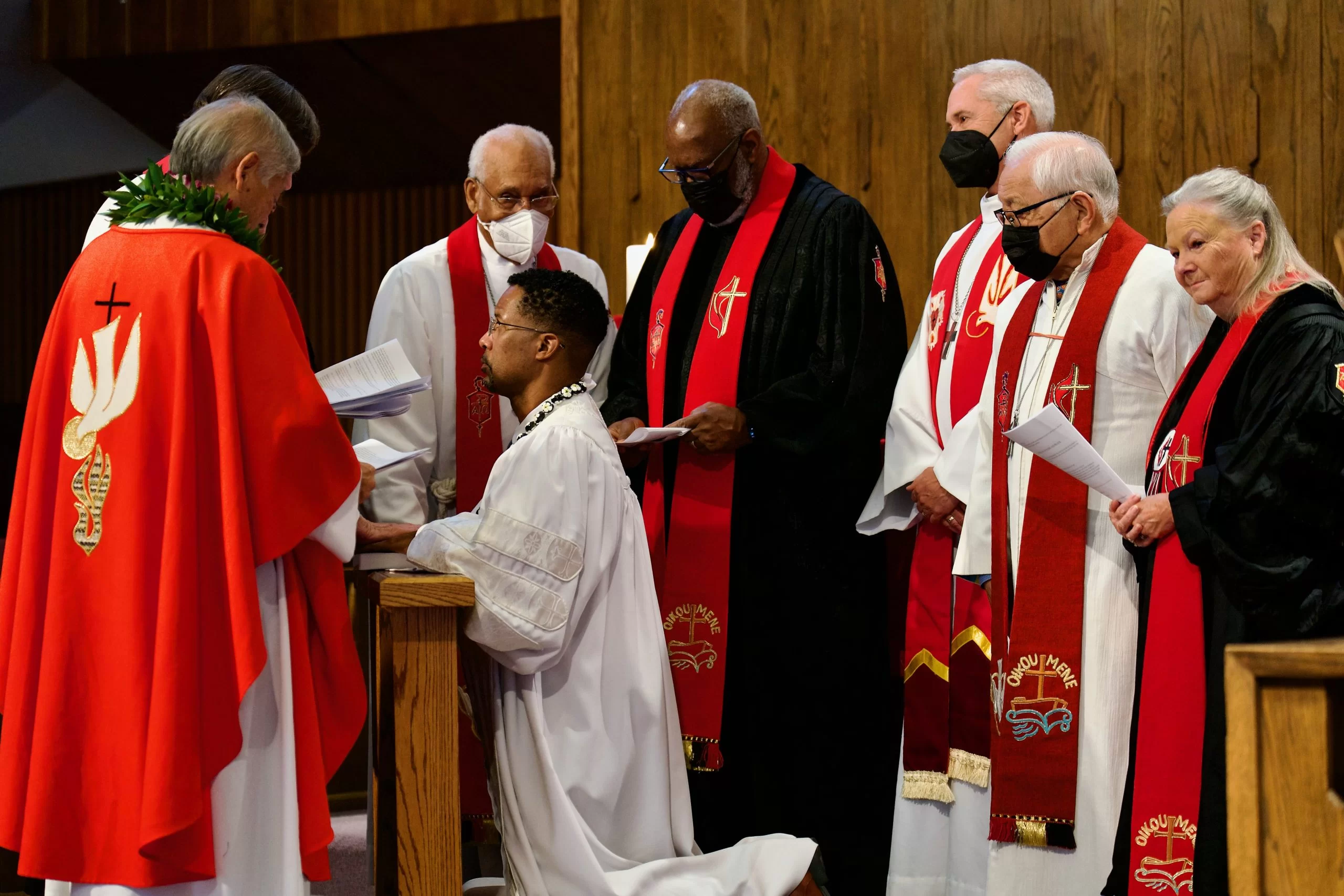
Bridgeforth brings experience, collaborative mindset into new role as bishop of the Greater NW Area

Growing up in rural Alabama, it was Bishop Cedrick Bridgeforth’s grandparents who made sure he got to church – even on the days he didn’t want to be there.

But it was in the church, Lakeview United Methodist and Oakville Baptist churches that he found purpose – even on the hard days. After serving in the U.S. Air Force and earning a bachelor’s degree in religion from Samford University and a master of divinity degree from Claremont School of Theology, he has found the joy, purpose and calling that led him to become a newly-elected bishop in The United Methodist Church.

“Hopefully, people can see that the degrees, the titles, and the experiences are not where I began. That’s just where I’m on the journey right now,” Bridgeforth said. “I do that in a way to connect with people. My leadership style is about connecting with people.”

On Jan. 1, 2023, Bridgeforth will begin serving as bishop of the Greater Northwest Episcopal Area of The UMC. The GNW Area comprises the Alaska Conference, Oregon-Idaho Conference and Pacific Northwest Conference. He currently serves as the director of communication and innovation for the California-Pacific Conference.

When he was elected on the 18th ballot at the Western Jurisdictional Conference in Salt Lake City, Utah, on Nov. 4, he became the first openly gay African American male to hold the title of bishop within The UMC. His husband, Christopher Hucks-Ortiz, stood by his side as he was welcomed. It’s history he’s proud to make, but it is only part of his story and ministry.

Raised on a farm in rural Alabama, Bridgeforth has served churches in the California-Pacific Conference since 1999. He became an ordained elder in full connection with the church in 2006. He has served at Bowen Memorial United Methodist Church and Crenshaw United Methodist Church, before supervising many churches as a district superintendent in Cal-Pac Conference. He also has been a clergy coach and nonprofit consultant, has served on the board of the Black Methodists for Church Renewal, worked as the director of academic programs and outreach at the University of LaVerne and is a published author, to name a few things.

Bishop Cedrick Bridgeforth addresses the crowd at the WJC 2022 after being elected with spouse Christopher Hucks-Ortiz by his side.

“I want my story to be open and available to people. There are parts of it people will connect with immediately. There are parts that people will hear and say, ‘I don’t get it.’ And that’s fine. All of us have that in our lives,” he said. “My leadership style is very personal. I try to be accessible to people. I like to hear people’s story because it helps me connect with them.”

On Sept. 11, 2001, he met his good friend – who later became his colleague – Dr. Larry Hygh, Jr., when Hygh and others attending the Strengthening the Black Church conference were stranded in Los Angeles due to the terrorist attacks on this country. Hygh said then-District Superintendent (now Bishop) Grant Hagiya sent church leaders out to check on those who were grounded in Los Angeles. Bridgeforth was one of those pastors.

Hygh recalls a caring presence in that moment. The two became better acquainted when, less than a year later, Hygh became the communications director for the Cal-Pac Conference and got to see what Bridgeforth’s ministry was like up close.

“I think he brings a gift of strategic leadership. I also believe he’s a person who can work with folks from various theological perspectives,” Hygh said.  “Even when he might not agree, he can find commonality for the sake of the gospel. Folks like him are what we need.”

Hygh said he’s always appreciated his friend’s ability to meet people – all people – wherever they’re at in life. Hygh watched Bridgeforth work, as a district superintendent in the Los Angeles area, with some of the most diverse churches, communities and neighborhoods in the country.

“He makes connections that sometimes other folks do not see,” Hygh said.

This past summer, Bridgeforth, an avid cyclist and supporter of HIV/AIDS research, encouraged Hygh to train for and participate in a 545-mile AIDS/LifeCycle bike ride from San Francisco to Los Angeles to raise money for the San Francisco Aids Foundation and the Los Angeles LGBT Center.

“He is a much faster cyclist than I am,” Hygh said. “I’m the caboose in the back.”

Nevertheless, Hygh said his friend rode with him in the back one day on the seven-day course and saw a different perspective.

“He’s a servant leader who walks the talk,” Hygh said.

Bridgeforth calls himself collaborative by nature and hopes to bring that work to his role as bishop. He describes it as “a necessity” at this time in the church’s life.

“For us to innovate at the rate we need to, we have to collaborate,” Bridgeforth said.

As he steps into the episcopal role in the Greater Northwest Area, he knows the church is at a critical point. Membership is in decline, and the church may be splintering as some churches seek to disaffiliate before the 2024 General Conference. He knows it’s something that the church will grapple with, and to do that, people must first maintain their hope in Jesus Christ.

“I’m not a person who believes divorce is a bad thing,” Bridgeforth said. “Sometimes divorce is necessary, and it is the only thing that will bring about healing.”

He said it’s a good thing for people to be clear about their values and to bless each other as they depart. But the faithful disciples who remain within the denomination need to be clear about why they have decided to stay – not just because some people they disagree with left.

“Did we remain United Methodists because we believe in the strength of Wesleyan grace? Do we believe in the strength of being connected? Do we believe that serving together is better than just serving on our own? Do we believe that there is truly hope in Jesus Christ? Do we believe we have a message of salvation and resurrection that can resonate in this season and in coming seasons? I’ll preach that; I’ll teach that,” Bridgeforth said. “I want to organize us so that we are delivering that message in every way possible. So that we examine our structures, we examine our policies, and our behaviors so that they align with this understanding of resurrection – of hope on the other side of division.”

*A transition team is working with Bishop Bridgeforth and his family to identify ways in which he will be introduced to our churches and communities over the next several months. We will keep you informed of those opportunities through our newsletter and social media channels as they become known.