Dignity and Degradation – A Puzzle
insideout: What if we focused on abundance?
Beware. Be very aware.
Arise, shine; for your light has come, and the glory of the Lord has risen upon you.
Then you shall see and be radiant; your heart shall thrill and rejoice.
Isaiah 60: 1, 5
Epiphany –a moment of sudden or great revelation or realization.
We were shaken awake in 2017 in America – with the sudden realization that sexual abuse and harassment by powerful people of less powerful people is rampant in American society. Most common is abuse of women by men: Harvey Weinstein, Bill Cosby, Matt Lauer, Charlie Rose, and so many more. But it can be anyone who uses their advantage to intimidate and exploit someone at a disadvantage. As we know, abuse isn’t always by men of women, it can be between two people of the same sex, women of men, adults abusing children or youth, the rich abusing the poor, or as was reported just this week, parents trafficking their own children for sex to finance their opioid addictions.[i]
Sexual harassment and abuse occur when a person has an inflated sense of their own importance and a distorted sense of their place in the world, which leads them to go where they don’t belong and take what is not theirs. You can hear their distorted thinking, when abusers say, “I thought the feelings were mutual,” or “I thought the sex was consensual.” The first (original) sin the bible tells us about is taking what isn’t yours. That’s what happened in the Garden of Eden, when Eve and Adam plucked and ate the fruit that wasn’t theirs to eat.
In October I was with clergy and other professional ministers in Alaska, when we began to hear about the gross abuses of film producer, Harvey Weinstein. I found myself talking with clergywomen about the inappropriate ways laymen and clergy colleagues treat them. Hugs that turn into gropes. Suggestive comments about personal appearance or physical fitness. A “stolen kiss.” What is a “stolen kiss” if not one that wasn’t given?
Though I am constantly aware of these dynamics at work in our lives, I had fallen into complacency and given up hope of change. To shake myself awake again, I began a personal “Me Too” journal of the encounters in my life that crossed boundaries. I have 18 items so far. As I began to write, lost memories returned. I didn’t think there would be so many. They fall far short of criminal actions. I think of them as encounters that taught me to be wary – to watch out for unspoken intentions, for hidden messages, for intrusions into my personal space.
And then I began to count the cases of clergy sexual abuse I have had a role in responding to as a district superintendent or bishop. More than 25, overwhelmingly men who used the trust of their office to gain sexual access to vulnerable women.
Today, as we remember that God repeatedly shines new light and calls people out of darkness, I want to share three messages.
To women and others who have learned to be wary. I’m sorry. You can be the beautiful, whole, beloved daughters (children) of God. Own and honor the integrity of your personhood: body, mind and spirit. If you feel unsafe around someone, don’t “be nice.” Protect yourself. If you feel another person may want something from you that does not belong to them and that you are not offering, don’t give them the benefit of the doubt. If a person invades your space, your security, or acts without your consent – tell someone. Do not become compliant or make excuses for your abuser if your personal integrity is under assault.
To anyone who has been sexually harmed by a Church leader. Sexual abuse, misconduct and harassment by a clergy person violates a sacred trust. As your bishop, I take reports of misconduct by clergy very seriously. If you have been harmed by a member or officer of a local congregation, I encourage you to share your experience with your pastor, or other trusted leader in the church. If you have been harmed by a clergy person, or an employee or elected officer of the Conference, report your experience to a district superintendent or other trusted Conference leader, who will work with my office to restore the sacred trust of the ordained ministry, and to find a just resolution to your concerns.
To clergy and others in trusted leadership in the Church. Do not confuse self-giving love with self-serving love. It is never OK for you to become sexually involved with people in your care. It is always your responsibility to maintain healthy professional boundaries. Don’t put yourself in a situation where your intentions might be misunderstood. The Church has given its stamp of approval to you as a safe, trustworthy spiritual guide and companion at the boundaries of life and death. Just as you have the power to heal, you also have the power to harm. Your sexual attentions are not a form of ministry, or therapy. If there is something in your life that you can’t share with anyone – you may be a danger to the people in your care. Find a spiritual advisor, counselor, or mentor to help you sort through your “stuff” and ensure that you are a trustworthy pastor. If you do not or cannot maintain the sacred trust of your office, for the love of Christ, step out of ordained ministry.
Let this season of awakening open us to a new way of being in relationship, in which men and women of all sexual identities and orientations, and regardless of power or wealth, honor one another, until the radiance of God’s glory shines upon us.
Send me your thoughts.
![]()
Bishop Elaine JW Stanovsky | Greater Northwest Area
[i] NPR – W.Va. Officials Warn Of Increased Cases Of Human Trafficking
insideout: Dispelling the Myth of Best Practices
This episode of insideout explores the essential role of deep listening in fostering true innovation, and what that means for a church often fixated on ‘best practices.’ According to Rev. Dr. William (Bill) Gibson, “it’s a mistake to think that a best practice is a silver bullet answer for a declining church that lacks innovation and creativity.”
Transcript:
Over the last fifteen plus years, the Church has tried to embody innovation through the phrase best practices.
In the business world, best practices were about maintaining quality and establishing benchmarks. In the Church, we’ve had a tendency to see best practices as a program option to ensure success. If they worked in that church, then surely they’ll work in our, right?
But here is a major problem. The church is not as adaptive as corporate America. Often, by the time we implement a best practice, we are behind the curve in a world that is changing before our very eyes.
In 2011, Stephen Shapiro wrote this valuable little book entitled Best Practices Are Stupid: 40 Ways to Out-Innovate the Competition. Now before you claim that I am hating on best practices let me offer some clarity. Neither Shapiro or myself through this video are saying that we should ignore best practices, not at all.
It’s important for us to know what is working in a particular context, and why it works. But it’s a mistake to think that a best practice is a silver bullet answer for a declining church that lacks innovation and creativity. Rather than a plug and play approach, we should be focusing on contextual problem solving. Instead of trying something that will attract people in our doors, we need to step outside of our walls and engage in deep listening with real people, not just guessing what they want.
Think about this. Jesus was innovative in how he talked. He engaged the cultural language while also, likely, having the ability to speak three languages: Aramaic, Hebrew and Greek. This allowed him to draw upon a number of cultural methods in order to convey his message. Jesus captured the attention of his populist audience through overstatement, hyperbole, pun, metaphor, proverb, paradox, poetry, irony, and the use of questions. Through these devices Jesus connected with people in very powerful and personal ways. He used every tool in his toolbox. He helped people to unlearn and relearn what they have been taught their entire lives. See the Sermon on the Mount.
In fact, in Matthew Chapter 5, de demonstrates this unlearning and relearning activity by saying things like you have heard the law that says this, now I say this. I love verses 43 and 44. Jesus says, “You have heard the law that says ‘Love your neighbor and hate your enemy.’ But I say, love your enemies, pray for those who persecute you.” Now that’s a verse that some Christians just simply want to ignore.
We sometimes forget that innovation is about change. The late Steve Jobs was famously quoted saying, “People don’t know what they want until you show it to them.” The next time that you’re tempted to plug-and-play a best practice, what if, instead, you learned from it? Then, stepped outside your doors, engaged the very people you want to reach, and listened carefully for what they don’t know they want. And then you show it to them.
That is innovation. What if you simply showed them faith, hope, and love. Faith, hope, and the greatest of these, love.
What if?
Rev. Dr. William D. Gibson serves as Director of Strategic Faith Community Development for the Greater Northwest Area of The United Methodist Church.
This episode of insideout was e-filmed and edited by Rev. David Valera. Valera serves the Pacific Northwest Conference of The United Methodist Church as Director of Connectional Ministries.
Insideout: Discover, Claim, Live
Transcript:
Have you ever experienced a tradition or activity that you thought was weird?
Or, simply found yourself saying things like, “I just don’t get it…”
Our tendency is to think that our perspective is the norm for society.
In these moments, we are not acknowledging the lens through which we see the world. We are not taking into account the vast cultures and subcultures of our world, country, region, and neighborhoods.
But this “weirdness” actually represents an inability or an unwillingness to realize that our way is not the only one. But you knew that; right?
We have to be willing to see the world from a different perspective, while checking our own.
In Matthew 13, Jesus teaches about understanding the secrets of the Kingdom of Heaven. Those who listen to his teaching are going to be given greater understanding. He goes on to say “Blessed are your eyes, for they see; and your ears, for they hear.”
Several years ago I was introduced to the teachings and work of Mikhail Bakhtin whose work connects our approach to intercultural competency.
He said, “In order to better understand a foreign culture, one has to step enter into it, forgetting your own, and view the world through the eyes of the foreign culture.”
In other words, we have to be willing to intentionally look at the world around us from a completely different perspective while checking our own biases.
In fact, that is what insideout represents for me. If you haven’t noticed, the “insideout” logo is backwards and that’s intentional.
Think of the logo being printed on the outside of a t-shirt. And as you put that t-shirt on, you look outward through the front. The logo is going to appear backwards. You’re looking from the inside-out.
It’s a reminder that we have to be aware of the lens through which we view the world — those voices and experiences that have shaped our identity — parents, grandparents, teachers, coaches, bosses, peers, enemies, etc. And we replay those voices over and over in our heads, don’t we?
To acknowledge and teach through this, I use three simple moves, Those moves are: Discover, Claim, and Live.
1) Discover — which refers to an intentional move to intersect and engage culture — maybe one that seems weird, different or foreign to you.
2) Claim — which asks us to rediscover from Scripture; from the gospels, ways of understanding our world, while claiming Jesus’ example.
And 3) Live — which challenges us to answer the “So, what?” question; a challenge to change and become a living example of Hope and Love to those around us.
Believe it or not, these simple moves, can help you find grace in the strangest of places…
Are you interested in making the world a better place? Then that has to start with you and with me…
What if we intentionally looked from a different perspective in order intersect culture, elevate the gospel, and challenge to change?
What if?
Rev. Dr. William D. Gibson serves as Director of Strategic Faith Community Development for the Greater Northwest Area of The United Methodist Church.
This episode of insideout was e-filmed and edited by Rev. David Valera. Valera serves the Pacific Northwest Conference of The United Methodist Church as Director of Connectional Ministries.
Special thanks to Rev. Craig and Sharon Parrish.

A message to the PNW: “Where are we headed?”
Installment #1: New West-Side Districts
The purpose of the annual conference is to make disciples of Jesus Christ for the transformation of the world by equipping its local churches for ministry and by providing a connection for ministry beyond the local church; all to the glory of God.[i]
Making disciples of Jesus Christ can be a tough mission in the midst of generational change, religious pluralism, and political polarization. The Pacific Northwest Annual Conference is trying to be good stewards of the resources we have and put all our energy into ministries that change lives and the world to reflect God’s vision of abundant life. Last June the Conference acted to reduce the number of districts from 6 to 5, even as we are learning new ways to strengthen ministry both through existing congregations and by starting new ministries.
The reduction in districts will occur on the west side of the Cascade Mountains. The new districts will become reality on January 1, 2018 but you won’t notice much change until July 1, 2018. At that time we will add the word “Missional” to the name of each district, as a reminder that churches exist not only to support their members, but also to engage their context. Every church, fellowship and ministry is on a mission frontier, where people hunger and thirst for spiritual community.
Your district superintendent, and district programming will continue as they are now through the end of June, 2018, to coincide with the pastoral appointment year. Current district superintendents will continue in place through June, 2018, and they will continue to relate to churches and clergy in their present districts through the 2017-2018 appointment season. Beginning July 1, 2018, there will be one fewer district superintendent and churches and clergy will align to the new districts.
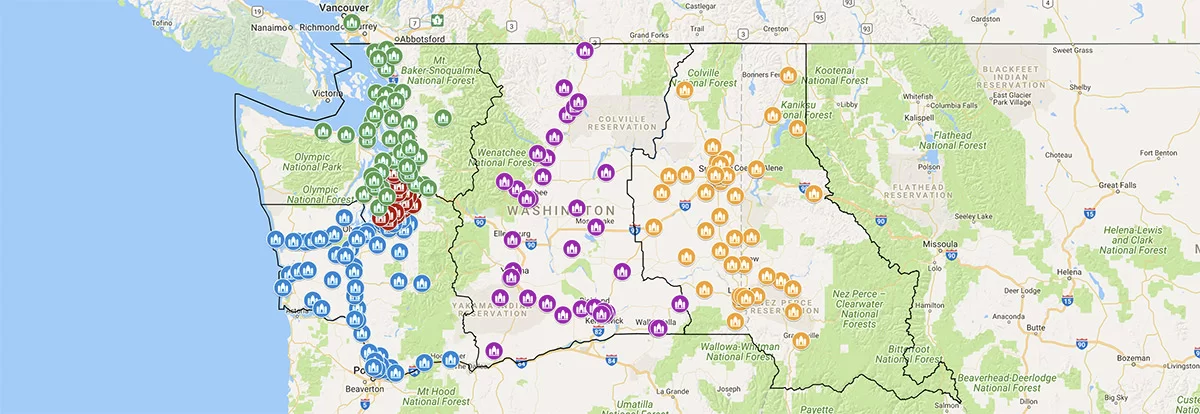
The assignment of churches to districts creates a new urban SeaTac Missional District, with the intention of developing specific initiatives for missional engagement in these growing urban areas, with their extreme economic disparities. Across the conference your staff is committed to both helping existing churches to engage their communities in new and life-giving ways, and to cultivating bold, new ministries that create new places for new people to become disciples of Jesus.
During 2018 churches will be aligned in districts as follows:
Inland Missional District: no change
Seven Rivers Missional District: no change
Puget Sound Missional District: [Click here for the list]
SeaTac Missional District: [Click here for the list]
Crest to Coast Missional District: [Click here for the list]
Click here to view a dynamic Google map of the new missional districts. An embedded version of this can be found at the bottom of this page.
Between January and June district superintendents will work with current leadership of groups like UMW, district lay leaders, district boards of church location and building, and disaster coordinators to adapt to the new district alignment. District superintendents are prepared to help you find answers to your questions.
God is saying, “Behold, I am doing a new thing…. Do you not perceive it?” (Isaiah 43: 19). We’re trying to do a new thing with God. I hope you will bring your patience and creativity to this time of transition.
May God guide and guard us through this change,
Living in Faith,

Bishop Elaine JW Stanovsky | Greater Northwest Area
[i] The Book of Discipline of The United Methodist Church, 2016, ¶ 601.
This year’s Bishop’s Symposium is No Joke: A Rabbi, an Imam, a Pastor and Brian McLaren walk into. . .
On Ending the Deferred Action for Childhood Arrivals (DACA) Policy
Give the emperor the things that are the emperor’s,
and God the things that are God’s.
– Matthew 22:21b
Greater Northwest United Methodists,
In the wake of yesterday’s announcement regarding DACA, I’m asking myself, what is the emperor’s and what is God’s? Matthew reminds us that the really important things belong to God and that what we owe to civil authorities is limited by what belongs to God.

Yesterday the White House announced an end to the Deferred Action for Childhood Arrivals (DACA) policy threatening to cause the deportation of 800,000 youth and young adults who were brought to the United States without documents when they were children. Today I remember that:
“The alien who resides with you shall be as the citizen among you; you shall love the alien as yourself, for you were aliens in the land of Egypt: I am the Lord your God.” – Leviticus 19:34
It’s not right even to threaten to deport peaceful, tax-paying immigrants who have lived here for decades, and know no other home. Doing so violates the teachings of the Bible.
Love of God demands that we speak out for our neighbors to government officials who have authority over their lives. Love of God might demand that we act boldly to protect threatened people and families as fiercely as we would protect our own.
The moral imperative to love the alien in our land is clear, though each person and each church will find its own way to love God and neighbor in their place and circumstance. I hope you will find ways to have serious conversations with people who are affected by this end to DACA, and to discern what God is leading us to do in the months ahead.
Pray for people who fear that their lives may be uprooted, and their families torn apart. Pray for our government authorities. Pray that Christ will guide and lead the church to a season of clear witness and courageous action.
With faith in Christ, and confidence that love will win,
Bishop Elaine JW Stanovsky | Greater Northwest Area
Resources
Visit greaternw.org/welcome for more DACA information and a list of ideas and resources to help us love one another, love our neighbors and love the stranger. On the page titled “Links for Further Information” you’ll find links to organizations active in supporting refugees and immigrants in each state (Alaska, Idaho, Oregon, Washington) alongside national and interfaith groups. Please send other local (to you) resources that you are aware of to the Rev. Lyda Pierce at lpierce@pnwumc.org for possible inclusion.
‘Love Made Liquid’ – Responding to Hurricane Harvey
Greater Northwest United Methodists and people of compassion everywhere,
LOVE GOD WITH ALL YOUR HEART, SOUL, STRENGTH AND MIND,
AND YOUR NEIGHBOR AS YOURSELF
DO THIS AND YOU SHALL LIVE. ~ Luke 10: 27

Hurricane Harvey is devastating Texas and Louisiana, stretching all systems of relief and recovery beyond their limits. We’ve watched as tiny babies, venerable elders, and people of every condition of life have had their lives swept away by the floods. Local United Methodists surrounding the affected area are already providing shelter, food and comfort to people in distress. They need us to support their work with “love made liquid” through prayer and offerings. And we’ll be sending Early Response Teams (ERT) from the Greater Northwest Area as early as October.
I am calling every church, fellowship group, Sunday School class, choir, coffee klatch, walking, or yoga group in the Greater Northwest Area (Oregon-Idaho, Pacific Northwest, and Alaska Conferences) to love God and neighbor in the following ways:
- Pray for the people affected by the flood and those who work tirelessly to respond, and
- Receive a special offering for HURRICANE HARVEY FLOOD beginning this Sunday, and each Sunday in September. And when you donate, invite someone outside your group to donate, too. Donations will support United Methodist Committee On Relief (UMCOR) US Disaster Response fund* and travel costs for Early Response Teams from the Greater Northwest Area that will go to Texas and Louisiana.
Miracles happen when people share what they have. Thank you.
Bishop Elaine JW Stanovsky | Greater Northwest Area
* 100% of donations support UMCOR recovery and relief with no administrative overhead. UMCOR has the highest (4 ★★★★) rating by Charity Navigator.
Contacts:
- Jim Truitt, Disaster Response Coordinator, Pacific Northwest Conference, umvimdrc@comcast.net
- Dan Moseler, Disaster Preparedness and Response Coordinator, Oregon-Idaho Conference, djmoseler@gmail.com
- Dan Wilcox, Disaster Response Coordinator, Alaska Conference, danielpwilcox@gmail.com
Related Items
Letter – Bishop Scott Jones – Texas Conference
Letter – Bishop Cynthia Fierro Harvey – Louisiana Conference
Video – Bishop Robert Schnase – Rio Texas Conference
Response – The Latest on UMCOR Response to Harvey
Response – Cleaning buckets and hygiene kits will be part of the response