Bishop’s COVID-19 Notice #4, April 23, 2020
WHAT’S IN YOUR POCKET? Sharing what we have with those who have less.
Members and friends of The United Methodist Church in the Greater Northwest,
“From everyone to whom much has been given, much will be required
and from the one to whom much has been entrusted,
even more will be demanded.” – Luke 12: 48b
“Earn all you can. Save all you can. Give all you can.”
– John Wesley, “On Money”
There is nothing fair about COVID-19. People are not equally vulnerable to it or protected from it. People don’t all have the same supportive community, the same emotional and spiritual resources. People don’t have equal access to health care. People do not all have the same resources to endure an economic downturn, unemployment or closed schools.
COVID-19 exposes injustices that are embedded in our social, economic and political systems. For some, this pandemic means an immediate survival crisis.
Sharing what we can when people are suffering comes as second nature to people who follow Jesus. If you have the ability to give money at this time of crisis, I am writing to encourage you to do so. If you are able, please consider one or all the following actions.
- Support your Local Church. Your church needs your support for as long as this crisis lasts and beyond. A check in the mail is a blessing.
- After you have given to your local church, if you can do more, please give a “thank offering” to the FUND FOR FAMILIES. Text the code “GNWFFF” to 44-321 or visit http://bit.ly/gnwfff to give. Local Churches will partner with community organizations to “practice being human” with people who are especially vulnerable to the impacts of COVID-19.
- If someone else may need your Stimulus check more than you do, consider “passing it along” to the FUND FOR FAMILIES (above).
Begin now to think now about whether you can share your salary if local churches become unable to support their clergy or lay staff salaries.
And, finally, if you can’t make financial contributions, offer what you can. Life-saving social distance. A prayer. A phone call. A kind word. A letter or note card. An email. FaceTime. Help with groceries. A favorite poem, book, song, photo or TV series. Weeding a garden. Blood donation. God is counting on us to share what we have.
I want each of you to take plenty of time to think it over,
and make up your own mind what you will give….
God loves it when the giver delights in the giving.
– 2 Corinthians 9:7, MSG

Bishop Elaine JW Stanovsky
An important update regarding the 2020 GNW Shared Annual Conference Session
April 16, 2020
Lay and clergy members of the Alaska, Oregon-Idaho and Pacific Northwest Annual Conferences,
Beloved in Christ, I am writing in the midst of the COVID-19 pandemic to notify you that I have canceled the Shared Annual Conference session scheduled for June 2020 at the Washington State Fair Grounds in Puyallup, Washington. The current global health crisis has required strong action on the part of public officials to protect the public health. We don’t know how long the present restrictions of public gatherings, commerce and travel will continue. In deference to public health considerations, to honor the members of the Conferences who must make hotel and travel plans, and in order to avoid a sudden decision close to the scheduled dates, I have made this decision now.

The Greater Northwest is not alone in facing this dilemma. We are living through unprecedented times, requiring adaptations to many of the customs and systems we have known. Alternative plans for the Conference sessions will be developed collaboratively with the cabinets and officers of the Conferences, as well as colleagues across the United States.
Canceling Annual Conference leaves many questions unanswered in the short run that will have to be answered before I can announce alternative plans to conduct the minimal, essential business of the Annual Conferences in a safe and timely manner. Just a few:
- How will nominations for the next quadrennium be handled?
- What about the clergy session: retirements, commissioning, and ordinations?
- Don’t we have to adopt a budget for 2021?
- Click here to submit your own questions.
I appeal to you for patience and grace as we search for an orderly way to administer the Conferences without compromising the health and safety of our members or the general public. I hope that we will be able to announce the alternative plan to do this very soon.
As we struggle to find our bearings in the turbulence of illness, separation, risk, and economic collapse, I am deeply grateful to each of you for your steadfast faithfulness to God’s promises of abundant life, and for your sacrificial commitment to the Church – your local church home, your neighborhood and the whole global United Methodist family.
Listen, taste and see. God is at work in the turbulence – doing a new thing. Do you not see it?
I wait with longing to be together again. In the meantime, we have challenges to face, work to do, lessons to learn. It’s a great, terrifying time to be alive. May God bless you and keep you until we can meet together.

Bishop Elaine JW Stanovsky
Wednesday Webinar with the Bishop: Freed from Death
But God raised him from the dead, freeing him from the agony of death, because it was impossible for death to keep its hold on him. – Acts 2: 24
Join us as we resume our weekly Wednesday webinar series with Bishop Elaine JW Stanovsky, on Wednesday, April 15, to share our Easter stories. The hour-long webinar begins at 9 amPDT, 10 am MDT, or 8 am AKDT. Clergy and laity from across the Greater Northwest Area are invited to participate.
We apologize for not communicating more clearly that there wouldn’t be a webinar during holy week, but the goal will be to hold this time each Wednesday, moving forward, as we navigate our way through this crisis.
This coming week Bishop Elaine will be discussing, with other panelists, where they see signs of resurrection – life that defies death – in this season of disease and death.
“Again Jesus said, “Peace be with you! As the Father has sent me, I am sending you.” – John 20: 21
Playing off the lectionary texts for April 19, the prayer and conversation will explore how you keep your own spirit rooted and refreshed in God’s Holy Spirit when death is so close and so real. There will also be discussion around how we minister to others in a time of physical distancing.
Please visit this link to register for Wednesday’s webinar. See you soon.
Simple instructions to make homemade masks
Advice from the Centers for Disease Control recently released states that, “a significant portion of individuals with coronavirus lack symptoms (“asymptomatic”) and that even those who eventually develop symptoms (“pre-symptomatic”) can transmit the virus to others before showing symptoms.
This means that the virus can spread between people interacting in close proximity —for example, speaking, coughing, or sneezing — even if those people are not exhibiting symptoms.
In light of this new evidence, CDC recommends “wearing cloth face coverings in public settings where other social distancing measures are difficult to maintain (e.g., grocery stores and pharmacies) especially in areas of significant community-based transmission.” ( See full article here.)
Health authorities warn not to rely on the homemade mask to protect you and still keep a safe distance of at least 6 feet from others when outside your home.
For those interested in making masks to wear in nonclinical settings or
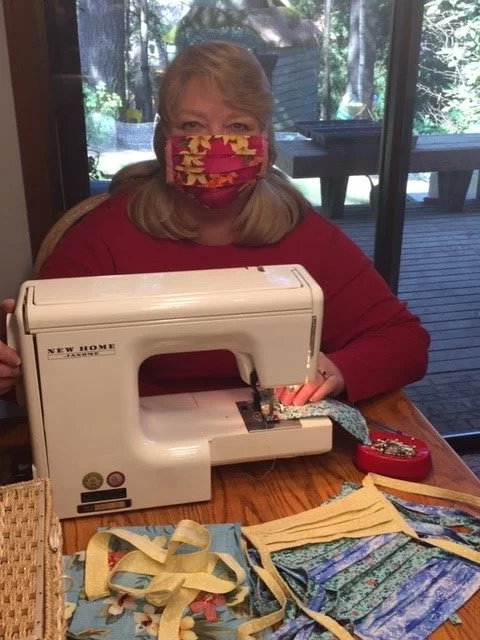
for personal use, Kaiser Permanente offers step-by-step instructions here. Be sure to instruct the receiver to wash it before wearing. There are several other mask instructions available on the internet.
Sally Blanchard, Oregon-Idaho Conference office and event manager, who has been sewing these said, “After you make the first one, they go quickly and are easy to make. Neighbors and friends have asked for them and it feels good to share what I can do.”
Bishop Stanovsky discusses pros and cons of Online Communion
Bishop Elaine JW Stanovsky briefly discusses some of the arguments for and against Online Communion. She reminds us that the WJ College of Bishops’ guidance does not require clergy to offer Communion online, and reiterates her trust in clergy to make good, reasoned decisions.
Transcription
Good afternoon. Yesterday after the webinar, a number of questions came to me about online communion and whether or not it’s appropriate for people to serve, for clergy to consecrate and invite people to receive elements in their own homes while we’re doing worship remotely. And so I wanted to just give you some quick responses.
As you know, United Methodist bishops in the Western Jurisdiction have given permission, with care, for this to be done during the virus epidemic. But I want you to be clear that the bishops are not prescribing that this must be done, or that everyone may feel comfortable, or it may be appropriate in every setting.
We understand communion to be a means of grace, that it’s a converting ordinance meaning that through communion God works through us as we confess and as we affirm our faith, and as we receive the elements of communion around the table or in community. When we come to the table, we’re inviting God to change us, to work on us, to make us more the people that we are intended to be, that we can be in the fullness of God’s grace. So changing the practice is a big deal and we should do it thoughtfully and prayerfully, if we do it at all.
So I’m going to give you the arguments, at least some of them, the pros and cons, of online communion.
In favor of online communion is Wesley, John Wesley’s admonition that communion is a duty. He talks about the duty of constant communion. It’s a commandment, “do this in remembrance of me. “Do it as often as you eat it and drink it.” And he doesn’t talk about frequent communion. In fact, he corrects himself and talks about constant communion. We must be in constant communion with God and Jesus our Savior. He talks about communion as being a blessing, as food for the soul, as a mercy from God to humankind.
Therefore, those who argue for online communion say it is disobedient not to constantly offer communion. And it’s a refusal of God’s gifts of love and mercy not to find ways to be engaged in communion. All that’s required, they say, is that we repent of our sins, that we seek to lead a new life, and that we live in charity with all.
Now the arguments against are a little more focused. They’re about the embodiment of the sacrament in the physical presence of the gathered community. The gathering of the community, God speaking and working to us in relationship with the people around us is absolutely essential for those who argue against online communion.
I want to offer you a word of grace. I’m not going to tell you what to do.
Communion is a means of grace and a blessing and so I’m not too worried about guarding it too closely. What if the means of grace got loose? Hmm, something interesting might happen.
And in our polity, in our church, clergy are entrusted with the sacraments, with baptism and communion. I trust the clergy with them. I ordained those clergy, at least some of them. I trust the clergy with them. I trust you clergy, my colleagues, to make good judgments and discernments and to practice appropriately in your context God’s means of grace.
I believe that God can work through what we do in faith. So if you offer online communion; if you don’t offer online communion; if you offer a love feast as an alternative; God can adapt. The Holy Spirit can find a way into the gathering of your community online as well as in person.
But I don’t want any clergy person to feel that they are being asked to do something they don’t feel comfortable with, they don’t feel has integrity with their faith and their understanding of the gospel.
I leave you with this line from one of Charles Wesley’s hymns, “the Spirit saves, the letter kills.” So be of good spirit, act faithful to the witness of the Holy Spirit with your holy spirit. Lead your communities with confidence and trust that God will make up the difference if we have fallen short.
God bless you as you prepare for worship on Sunday and in the weeks to come as we continue to practice safe distancing so that the coronavirus can touch and harm as few people as possible. God bless you all.
For Further Study
- The Sermons of John Wesley – “The Duty Of Constant Communion”
- Western Jurisdiction Bishops offer guidance for the Observance of Holy Communion
- Discipleship Ministries: “The Online Communion Dilemma”
- This Holy Mystery: A United Methodist Understanding of Holy Communion
- UM&Global: Global United Methodist Views on Online Communion
Celebrating Easter together during this time of physical separation
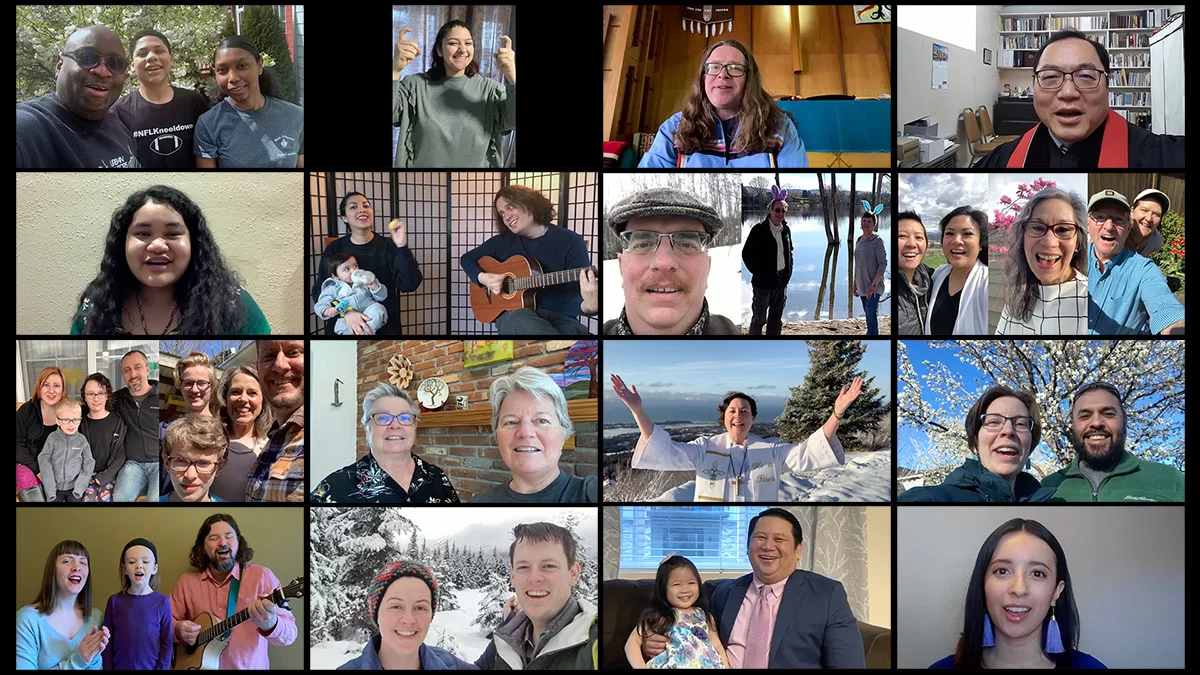
Production is underway for a Greater Northwest Area-wide celebration of Easter, and we are inviting you to participate! Bishop Elaine JW Stanovsky will deliver an Easter message complemented by the musical and vocal gifts of people across the Area.
Lay and clergy members are encouraged to send one favorite church-related Easter photo for possible use during a portion of the Easter celebration.* Please submit one photo to photos@greaternw.org by noon on Friday, April 3, 2020. Photos should be at least 1920 pixels wide x 1,080 pixels high.
Bishop Stanovsky has invited Oregon-Idaho Conference Secretary, the Rev. Laura Jaquith Bartlett, to design the worship experience along with Pacific Northwest Conference Director of Connectional Ministries, the Rev. David Valera.
They are producing the 30-40-minute service so that local churches can adopt it in its entirety or choose elements to blend into what they are already preparing. The elements include the Bishop’s message, a variety of musical components, and special liturgy created for this unique Easter celebration.
A weblink to downloadable video files will be distributed to assigned and appointed local church pastors no later than Wednesday, April 8.
The full worship service will be available to view on Easter morning at 7 am Mountain Time, 6 am Pacific Time, and 5 am Alaska Time at the following locations:
- Greater Northwest Area Facebook – Visit
- Greater Northwest Area Vimeo Page – Visit
- Alaska Conference Facebook Page – Visit
- Oregon-Idaho Facebook Page – Visit
- Pacific Northwest Facebook Page – Visit
Local churches on Facebook are encouraged to consider using the Watch Party feature to participate in this service offering alongside other members of their local church.
*By submitting a photo, you are giving permission to The Greater Northwest Area of The United Methodist Church, its churches, and its organizations to use the image provided.
Únase al seminario web, “Webinar”, este próximo miércoles con nuestra Obispa
La obispa Elaine JW Stanovsky invita a los pastores/as y a los laicos en las tres conferencias del Gran Área Episcopal del Noroeste a un seminario web, sobre el impacto que el Coronavirus está teniendo en las iglesias locales de la región.
El seminario web se llevará a cabo este miércoles por la mañana, 1ro de abril, a las 9 a.m., hora del Pacífico (8 a.m., hora de Alaska y 10 a.m., hora de la montaña).
Para participar en el seminario web, debe HACER CLIC AQUÍ para registrarse con anticipación. El registro ya está disponible y todos los laicos y clérigos metodistas unidos en el Gran Noroeste son bienvenidos.
Después de registrarse, recibirá un correo electrónico de confirmación con información sobre cómo unirse al seminario web. Para aquellos que no hayan usado Zoom antes, visite https://greaternw.zoom.us/test antes de la reunión para probar su conexión y descargar el software necesario.
También puede llamar al seminario web por teléfono para escuchar. Los números de llamada se proporcionarán a las personas por correo electrónico después de que se registren.
El seminario web ofrece una oportunidad para que las participantes puedan enviar preguntas durante la conversación y que estas preguntas pueden ser respondidas por la Obispa y otros panelistas que serán invitados a la discusión.
Families First Coronavirus Response Act (FFCRA) Q&A for Churches
What does the FFCRA require?
FFCRA requires certain employers to provide new, and temporarily available, paid leave to employees who are impacted by COVID-19-related issues in certain ways. Specifically, the FFCRA requires those employers to provide up to 80 hours of paid sick leave and up to 12 weeks of leave under the Family and Medical Leave Act (“FMLA”), the first 10 days of which are unpaid.
Does the FFCRA apply to churches and other religious organizations?
In general, the FMLA applies to any employer which is “engaged in commerce” and which employs at least 50 people. For the purposes of the leave provided by the FFCRA, an “employer” must be engaged in commerce and must have fewer than 500 employees. Thus, churches and religious organizations that already must comply with the FMLA will likely have to provide the 12 weeks of leave created by the FFCRA, unless they have 500+ employees. Those that have not previously been subject to FMLA requirements because they have fewer than 50 employees will have to provide the 12 weeks of leave if they are engaged in commerce.[1]
The paid sick leave requirement applies to the same set of employers – i.e., employers engaged in commerce that have fewer than 500 employees.[2]
When is the FFCRA effective?
The FFCRA paid leave requirements become effective as of April 1, 2020 and remain in effect through December 31, 2020.
Do part-time employees receive 80 hours of paid sick leave?
No. Part-time employees are eligible to receive an amount of paid leave equal to the average number of hours the employee works over a 2-week period.
How would an employee be eligible for the paid sick leave?
An employee would be eligible to receive this paid leave if the employee is unable to work or telework for any of the following reasons:
- The employee is subject to a Federal, State, or local quarantine or isolation order related to COVID–19.
- The employee has been advised by a health care provider to self-quarantine due to concerns related to COVID–19.
- The employee is experiencing symptoms of COVID–19 and seeking a medical diagnosis.
- The employee is caring for an individual who is subject to an order as described in one of the first two items in this list.
- The employee must care for a child because the child’s school or daycare is closed or because the child’s childcare provider is unavailable due to COVID–19 precautions.
- The employee is experiencing any other substantially similar condition specified by the Secretary of Health and Human Services in consultation with the Secretary of the Treasury and the Secretary of Labor.
How much is the employer required to pay an employee who takes this paid sick leave?
In general, the employee would be paid the employee’s regular rate of pay, if the employee is taking the sick leave because of one of the first three reasons listed above. However, an employer would not be required to pay more than $511 per day and $5,110 total.
If the employee is taking the sick leave for one of the last three reasons listed above, the employer must pay the employee at least 2/3 of the employee’s regular pay rate, up to maximum of $200 daily and $2,000 total.
Can an employer require an employee to use already-provided paid sick leave first?
No. If an employee is unable to work for any of the six reasons listed above, the employee may choose to first use the up to 80 hours of paid sick leave provided by the FFCRA. This paid sick leave is in addition to other paid leave provided by the employer.
How would an employee be eligible for the 12 weeks of FMLA leave?
The 12 weeks of FMLA leave provided by the FFCRA are available to an employee who is “unable to work (or telework) due to a need for leave to care for the son or daughter under 18 years of age of such employee if the school or place of care has been closed, or the child care provider of such son or daughter is unavailable, due to a public health emergency.”
Are all 12 weeks paid?
No. The FFCRA does not require the first 10 days of the FMLA leave to be paid. However, an employee may substitute other paid leave provided by the employer (vacation, sick, personal, etc.) during those 10 days. The employee could also use the 80 hours of paid sick leave provided by the FFCRA for those 10 days. Afterwards, an employer must then provide paid leave for up to 10 subsequent weeks.
How much is the employer required to pay during those 10 weeks?
The FFCRA requires an employer to pay at a rate that is at least 67% of the employee’s regular pay rate. However, the employer is not required to pay more than $200 per day, even if that is less than 2/3 of the employee’s regular pay rate. The FFCRA also limits the total amount that must be paid by the employer over the 10-week span to $10,000.[3]
Are churches and religious organizations eligible for the tax credits associated with these paid leaves even if they do not pay income taxes?
Yes. A church or other religious employer has access to tax credits to offset the costs of providing the paid leave required by the FFCRA. The credits are not against income taxes but are instead immediately applied to payroll taxes submitted and paid via IRS Form 941.
Are there limits to the amount of credits that can be claimed?
Yes. The credit that can be claimed for paid leave provided to an employee pursuant to the FFCRA is limited to the maximums that employers are required to pay for such leave. For example, if an employer paid an employee who was unable to work for 12 weeks in order to care for a child whose daycare facility was closed because of COVID-19 a total of $15,000, the employer could only claim a credit for $12,000.
Are any other costs recoverable?
The FFCRA provides for an additional credit based on the healthcare insurance costs related to an employee who takes paid leave under the FFCRA.
What other resources are available?
The Department of Labor has released the following:
- A set of questions and answers.
- Fact sheets for employers and employees.
- A poster that must be posted or otherwise provided to employees.
The Internal Revenue Service has made some information available about the process for claiming credits against payroll taxes. Additional guidance from both is expected over the coming weeks.
This Q&A document is for informational purposes only and should not be considered as legal or tax advice. Organizations with questions about the applicability of the FFCRA to their specific circumstances should consult with a legal or tax professional.
[1] Whether or not an employer is engaged in commerce depends upon the facts and circumstances applicable to that employer. Churches and other religious organizations could be deemed to be engaged in commerce if they, among other possibilities, have unrelated business income or operate a camp, day care, school, etc.
[2] The FFCRA does allow for an exemption for employers with fewer than 50 employees if providing the paid leave required by the FFCRA would “jeopardize the viability of the [employer] as a going concern.” This exemption would be governed by regulations issued by the Department of Labor.
[3] If combined with the 80 hours of paid sick leave provided by the FFCRA, the employee would be eligible to receive up to $12,000 over a 12-week span.
Question: Can we meet outdoors on Easter?
The following question was posed this week to Bishop Stanovsky by a pastor serving in the Greater Northwest Area. It has been edited lightly for clarity.
QUESTION
Bishop, I heard Governor Cuomo’s address this morning and one of the things he noted is that the blanket action to close everything needs to be made with the added information they have gained. He said now strategic decision making needs to be brought to bear so that portions of the population that need to stay home should and others could be allowed to go to work and start the economy slowly and thoughtfully. There are populations that need to stay home and some don’t if they follow the strict CDC protocols.
I hope in making your decision about church closures, you will consider these differences in the populations and areas most affected and those which are not. For instance, before the church closures, we had urged people in high-risk populations to stay home and use precautions. Those who were not, if they felt they were safe, could come to worship where we practiced strict sanitary protocols and spatial distancing.
One of our members recently offered to use his outdoor stage and field for an open-air Easter Celebration and place chairs safely apart if we want to use it instead of the sanctuary. His offer is gracious and he is thinking of how to have an Easter Celebration safely.
This is the time of strategic decision making I think Governor Cuomo was referring to. Just my thoughts as you make your decision. I am praying for you as always.
– Pastor
ANSWER
A week ago, I was imagining the faithful scattered sparsely on hillsides shouting Alleluia on Easter Sunday. The person who has offered an outdoor space is thinking creatively and generously. However, this is not the year.
The states of Oregon, Washington, and Idaho have all issued Stay at Home orders that do not permit gatherings of any size, even if social distances are kept. An outdoor gathering for Easter worship in any of these three states is not allowed under orders in effect and put public health at risk. As I prayerfully gather and weigh all the evidence and listen to the orders of our public officials, I am moved by conscience and obedience to the law of the states and the law of love to insist that United Methodists postpone from gathering until the danger is past and restrictions lifted.
My directive applies to all four states in the Greater Northwest out of an abundance of caution and concern for public health.
– Bishop Elaine
Related Information
Alaska – Health Mandates
Idaho – Order to Self-Isolate
Oregon – Order to Stay Homes, Save Lives
Washington – Proclamation to Stay Home – Stay Healthy